
International study involving UFSC shows impact of droughts on tropical trees
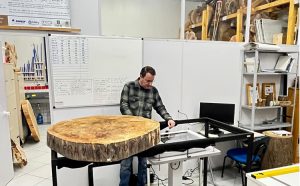
Professor Marcelo Callegari Scipioni analyzes a sample from a disc. Photo: UFSC Curitibanos
The Universidade Federal de Santa Catarina (UFSC) is one of the institutions that contributed to an international study on the impacts of droughts on tropical tree growth published in the journal Science. The study analyzed more than 20,000 tree-ring series spanning 483 locations in 36 tropical countries.
The results indicate that, over the last century, droughts reduced stem growth by an average of 2.5%, with significant recovery in the year following the drought. However, the researchers warn that the effects of droughts are intensifying and may compromise tropical forests’ ability to sequester carbon in the future, exacerbating climate issues.
UFSC contributed unpublished data generated at the Curitibanos Campus, based on the analysis of growth rings of the Araucaria angustifolia species, obtained from a native forest remnant located in the campus’ experimental forest area. These data were produced as part of research projects on giant trees, funded by the National Council for Scientific and Technological Development (CNPq) and the Research and Innovation Support Foundation of the State of Santa Catarina (FAPESC). The participation was coordinated by Professor Marcelo Callegari Scipioni, from the Department of Agriculture, Biodiversity and Forests, affiliated with the Forest Resources Laboratory of the School for Rural Sciences at UFSC.
The research used methods from dendrochronology, the science that studies the annual growth rings of trees as indicators of past environment and climate. According to Professor Scipioni, these rings serve as natural records of climatic and ecological events. “The Araucaria is the species with the largest number of dendrochronological studies in southern Brazil. The database generated by several researchers on this species was essential for filling geographic information gaps in the global study published in Science. It functions as a keystone species, both ecologically and scientifically, allowing us to understand the responses of subtropical forests to climate change,” explains the researcher.
Carbon sequestration capacity
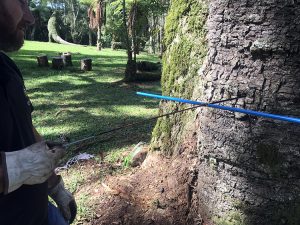
Extractor used to take a sample from the tree trunk. Photo: UFSC Curitibanos
As the effects of droughts intensify, the ability of tropical forests to sequester carbon may be compromised, the authors warn. “When forests stop sequestering carbon, or when previously stored carbon is released, as occurs during deforestation and fires, there is an increase in the concentration of CO2 in the atmosphere, intensifying the greenhouse effect and, consequently, global warming,” explains Professor Scipioni.
Large trees, in particular, store significant amounts of carbon, the researcher points out. This is why their felling results in proportionally higher emissions. However, some of this carbon can remain stored for longer if the wood is used for durable purposes – such as furniture, building structures, or wooden flooring – as long as it is not burned, the professor adds.
Study brings together more than 100 researchers
The research also involved Professor Amanda Köche Marcon, from the Department of Natural and Social Sciences at UFSC Curitibanos, who contributed growth ring chronologies of Araucaria angustifolia and Cedrela fissilis derived from her doctoral research.
The international study published in the journal Science was led by teams from Wageningen University & Research (Netherlands), Universidade Estadual de Campinas (Unicamp), Shahjalal University of Science and Technology (Bangladesh) and the University of Arizona (United States), and authored by more than 100 researchers from various tropical regions of the planet.
Giant trees: challenges and equipment
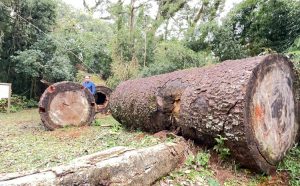
Giant trees are the subject of research at UFSC. Photo: UFSC Curitibanos
Professor Marcelo Scipioni coordinates the cataloging of giant trees in southern Brazil and manages the website “Giant Trees in Brazil“. According to the researcher, the work aims to date the largest Araucaria and Imbuia trees — the latter a symbol of Santa Catarina — in addition to investigating the environmental records contained in their growth rings. “Studying these trees is challenging: they are rare and often present anomalies, such as missing or false rings, which makes cross-dating difficult. To overcome this, we also use many young trees in dendrochronological studies,” explains the professor.
Currently, the UFSC Forest Resources Laboratory in Curitibanos has a digitizing table specifically designed for large wood samples — the well-known discs. According to Professor Scipioni, this equipment is unique in the world. The table is equipped with an A3 scanner, and the images generated are being used in a research mission at the Salk Institute for Biological Studies in the United States to develop artificial intelligence-based tools, in a project funded by CNPq.
In addition, bark and wood samples will be analyzed using carbon-14 dating to help determine the age of giant trees. The work also involves producing seeds and seedlings from these trees, aiming to preserve the species in the face of climate change by promoting planting at higher altitude areas in the Santa Catarina mountain region – a process known as assisted migration. These projects are supported by FAPESC and CNPq.
Translated by SINTER/UFSC.
Read the original article here.


