

Library Science


 The Library Science program trains professionals capable of locating, storing, retrieving and organizing information in any medium: from books and paper documents to those stored in electronic databases or available on the Internet.
Diversity and versatility are hallmarks of the Library Science graduate, who is skilled in creating information access tools and conducting library marketing and promotional activities. Graduates can find employment in a variety of settings, including companies, organizations, law firms, trade unions, museums, newspapers, and federal, state, or municipal government agencies that have libraries or documentation centers.
In the computer lab, students develop research techniques especially focused on the internet, which is gaining increasing relevance, as it creates new job positions. Other traditional areas of study are also included in the program.
The curriculum is comprised of around 50 courses, grouped into three areas: general foundations, including courses taught in other programs; instrumentals, which covers subjects in the fields of languages, logic and research methods and techniques; and professional training, which provides students with the theoretical foundations of library science.
Throughout the program, students can engage in a number of outreach activities developed in two support libraries: the Education Library and the Virtual Library in Library Science and Information Science. Additionally, they have access to the Document Conservation and Restoration Laboratory and the Information Handling Laboratory, which is dedicated to the study and thematic analysis of texts and books, providing a valuable opportunity to explore different fields of knowledge.
| Program Length: 8 semesters (4 years) |
| Website: biblioteconomia.ufsc.br |
| Classes held in the evening. |
 UFSC Law program is derived from the Faculty of Law of Santa Catarina and it was the first Law degree to be offered in the state, established in Florianópolis in 1932. It became part of UFSC in 1960.
 UFSC Journalism program prepares students for a career as reporters, photographers, editorial designers, writers or editors in newspapers, magazines, radio, TV, internet, news agencies and press offices, either employed, as a freelancer or as an entrepreneur.
 Recent transformations in the international landscape have introduced significant challenges for higher education institutions. Since the end of the Cold War, numerous events have shaped the practice of international relations. These include the rise in trade and capital flows, increasing competition for non-renewable resources, and large-scale geopolitical changes such as the creation of new nation-states, integration processes, and territorial conflicts.
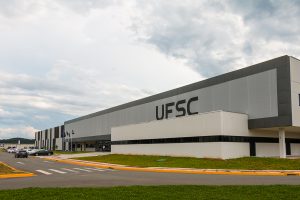 The Science and Technology program equips students with a strong foundation in the exact sciences, preparing them to work in a wide range of fields. With knowledge of current technologies and the ability to analyze and solve complex problems, graduates will have the skills to use and apply mathematical and computational tools in the business, financial or industrial sector.
 The Information and Communication Technologies (ICT) program focuses on computer applications, preparing professionals with the necessary skills to use, design and develop ICT solutions in economic, social and cultural environments.
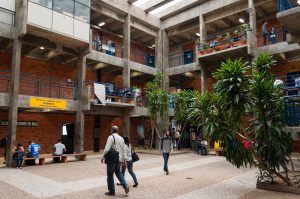 With the ever increasing level of computerization in contemporary society, companies, industries and organizations are demanding professionals that not only master the existing resources, but that are able to create new options for information processing. UFSC Information Systems program prepares professionals who meet this profile, with full competence to design, develop and operate computerized systems.


